Winter's Gibbet

In times past, a corpse gibbeted at the roadside made for a gruesome albeit not unfamiliar sight, a stern reminder of the fate of those who had grievously transgressed the law. Highwaymen, murderers and robbers were those most frequently exhibited in this fashion, generally posthumously after their hanging, placed in chains or an iron cage. There they would hang, often for years, creaking in the wind and emitting a fearful stench, until their remains had finally rotted away, and their bones fallen to the ground. Indeed, the Murder Act of 1751 stipulated that the bodies of all of those who had committed this crime should never be buried, but rather had to be hung from a gibbet, or sent to the surgeon’s dissection table. Thus it was that the law impressed itself in visual fashion upon the highways of Georgian England. It would not be until the 1834 repeal of the Hanging in Chains Act that this practice would formally come to an end, although the last gibbeting in England had occurred two years earlier in 1832.
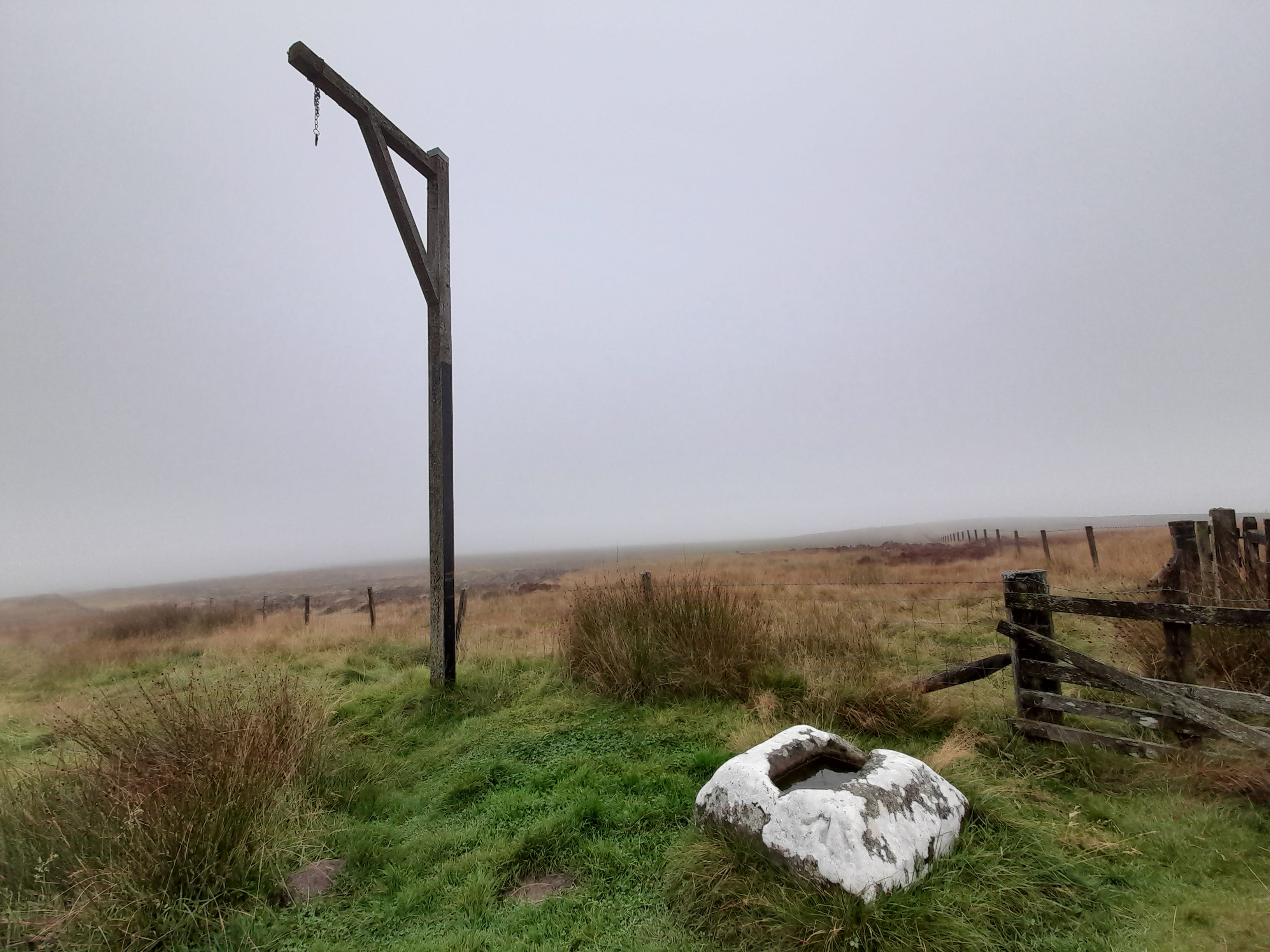
Few reminders of the gibbets of yesteryear remain, although memories of their presence linger on in local histories and folklore. One of the best known – Winter’s Gibbet – may be found high up on the Northumberland hills, next to the old drove road that traverses Steng Moss. Replaced many times over the years, this wooden structure once exhibited the remains of William Winter, who had murdered Margaret Crozier, an elderly resident of Raw in the parish of Elsdon. It was near this spot that he did away with the old woman, and so this was where his body was taken after his execution, hung in irons, and left to decay; a salutary reminder to all who passed of the fate awaiting those who chose to transgress the law in so heinous a fashion.
The crime took place late in the summer of 1791. On the evening of 29 August, Margaret Crozier, who sold goods from her shop to locals and passers-by, was enjoying the company of two friends when their leisure was disturbed by the frantic barking of a dog not far from her house. Disturbed, yet unable to divine the cause of the dog’s distress, her friends made their excuses and left. The very next morning the unfortunate woman was found dead in her bed. Her throat had been cut, with the wounds to one of her palms bearing testimony to her desperate and futile struggle with her killer. Next to her body lay a bloodstained butcher’s knife. As to the motive, it was assumed to be theft, for certain items of clothing, as well as cloth, were found to be missing. News of the murder spread fast amongst this close-knit community, and it was not long before a boy was prompted to volunteer detailed descriptions of a man and two women whom he had seen the day before, using just such a knife to apportion food.
Three suspects answering the descriptions provided by the boy and his companion were apprehended shortly afterwards: William Winter and his two sisters, Jane and Eleanor Clark. The trio were found to possess links with gypsy criminal bands known as the ‘Faw Gangs’ who frequented the area at the time. Winter’s guilt was sealed by his bloodstained shirt. He and his sisters were gaoled in Morpeth, where they waited many months, eventually being sentenced to death by hanging at Newcastle’s Moot Hall in August 1792. Of the three, only Winter admitted his guilt to the murder, but his sisters were hanged all the same. Whereas his body was carted off to his eponymous gibbet, the corpses of his sisters were utilised in the dissection rooms of local physicians. A crowd of thousands was said to have journeyed to Steng Moss to witness Winter’s remains being hoisted aloft.
The stench from the murderer’s decomposing corpse was such that travellers and horses alike found it so repulsive that they baulked at passing, until the passage of time eventually reduced it to nothing more than a collection of bones, which were then gathered up, placed in a tarred sack and hung from the rope. When this sack too finally decayed and disgorged its contents, the dead man’s bones were taken and buried beneath the moorland sod. The gibbet eventually rotted away, but the memory of the malefactor proved so strong that it has been rebuilt on more than one occasion, and a replica stands to this day. On occasion, the facsimile of a man’s head has been placed dangling from its rope, fashioned from either stone, or more latterly fibreglass, but the head tends to be stolen, and there was no such head to be seen at the time of my visit. However, Sir Walter Trevelyan, who paid for the gibbet’s initial replica, complete with a full wooden effigy of the hanged man, placed it some distance away from the site of the original. Even so, it is this replica that some claim to be haunted by Winter’s spirit. Details as to the precise nature of this haunting are, as is so often the case, as intangible as the ghost itself.
The destruction of the first gibbet was accelerated by the folk belief that splinters and parings of wood taken from its stock would prove efficacious in curing toothache. As for the curious lump of socketed sandstone that stands close to its replacement’s base, it once served to hold an Anglo-Saxon cross, although no trace of the said cross would seem to remain. Its stories, whatever they may once have been, are lost. It remains mute at so bleak and atmospheric a spot, where the imagination can readily conjure up the clank of a dead man’s chains.
Should this have whetted your appetite for such fare, many more folkloric and historical curiosities may be found within the pages of Curious England Volume Four and its companions.